


Indoor 5G benefits everyone, but who should pay for it?
Over the past two articles, we have looked at why private 5G and public mobile coverage do not necessarily need to remain separate infrastructure decisions, and how MOCN can create a way for different networks to make use of the same radio layer without becoming the same network.
All of which leads to a rather important commercial question. If the same in-building infrastructure can create value for the enterprise, its employees, visitors, building owners, tenants and mobile operators, should we still expect one party to pay for all of it?
This is important because the economics of indoor mobile coverage have always been one of its biggest obstacles. Technically, we know how to improve connectivity inside buildings, but the more difficult problem has often been deciding who benefits enough to justify the investment. Shared infrastructure could begin to change that conversation.
The problem with asking ‘who pays?’
Traditionally, an indoor mobile coverage project is relatively easy to describe. Coverage is poor. The organisation wants to improve it. Infrastructure needs to be installed. Somebody has to pay. The problem is that the party being asked to fund the network is not the only one that benefits from it.
Employees gain better connectivity. Visitors and customers receive a better experience. Tenants occupy a better-connected building. Mobile operators improve coverage for their subscribers. Building owners can offer better digital infrastructure.
Yet the cost of solving the problem has often been viewed through the lens of a single deployment with a single primary purpose. That becomes even harder to justify in smaller offices, venues, industrial buildings or campuses where the economics may not support substantial dedicated public-mobile infrastructure.
But it’s interesting to think about what might happen when public coverage is no longer the only reason for deploying the network.
One infrastructure layer, several sources of value
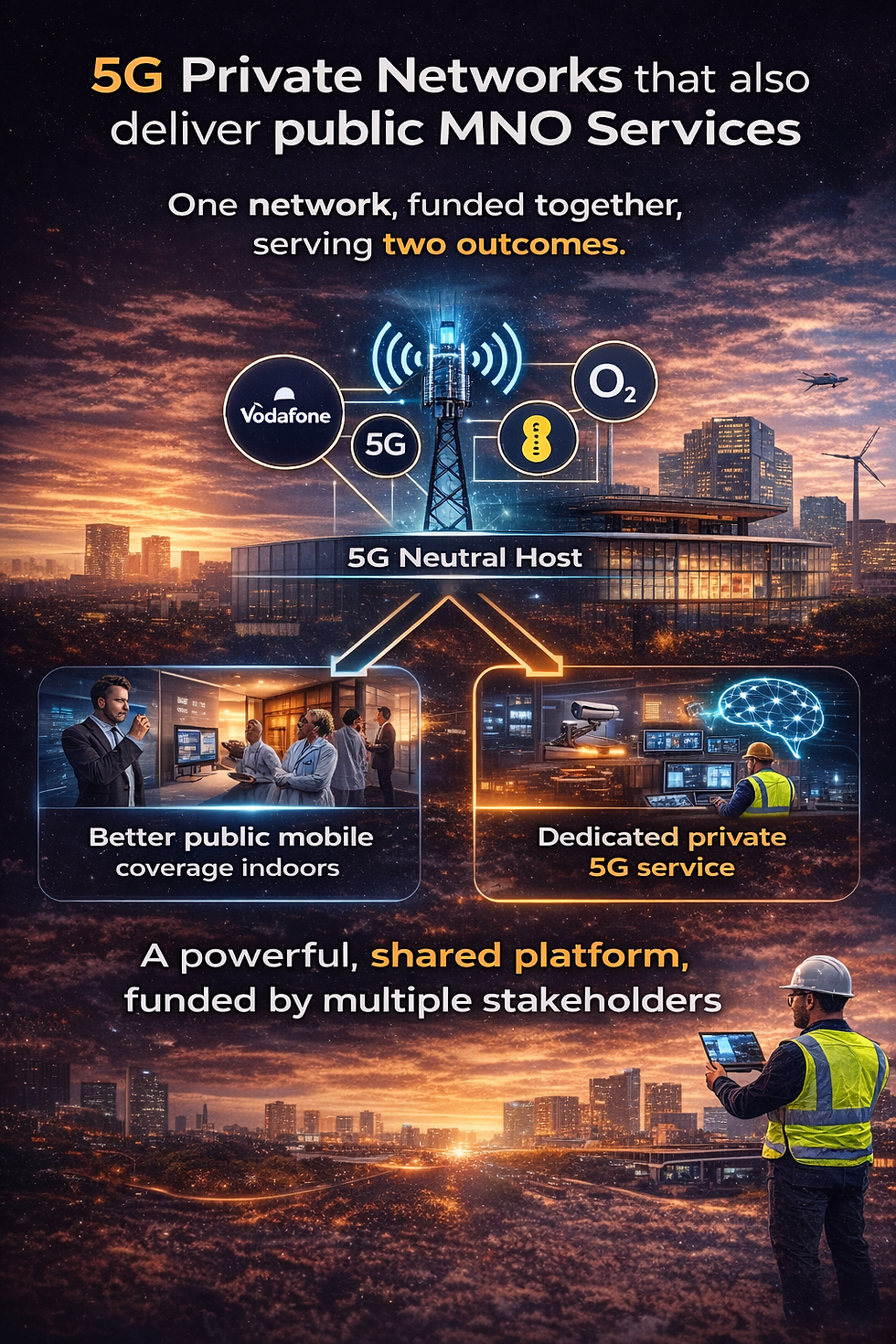
Private 5G changes the starting point because the enterprise may already have an operational reason to invest. Automation, cameras, logistics, communications, connected equipment or other applications can create the initial business case. As I discussed previously, private 5G can become the anchor investment, with public mobile coverage added as another use of the same physical radio infrastructure.
At that point, the network starts creating value in several different ways. For the enterprise, it provides controlled connectivity for operational systems. For employees, customers and visitors, it can improve everyday public mobile service. For a building owner, it potentially creates a more capable piece of digital infrastructure without requiring multiple overlapping radio deployments. For tenants, it could mean access to better public coverage and potentially private services without each occupier needing to solve the problem independently. For mobile operators, shared infrastructure offers another route to improving indoor service without requiring a completely separate radio layer in every building. And for a neutral-host provider, the same infrastructure can potentially support more than one service model.
The important point is not that every stakeholder receives the same benefit. They clearly do not. It is that the infrastructure is no longer solving just one problem for just one party.
From connectivity cost to building infrastructure
There is a broader change here in how we think about connectivity inside buildings. For years, mobile coverage has often been treated as something to be fixed when it becomes a problem. If the signal is poor enough, somebody investigates what infrastructure is required and whether the business case exists to install it. But connectivity is increasingly fundamental to how buildings operate.
Once the same cellular infrastructure can support operational systems as well as public mobile services, it begins to look less like a standalone telecoms project and more like part of the building’s underlying digital infrastructure. Building owners already make investments that support multiple occupiers and use cases such as power, security, access systems, structured cabling and other shared services.
Cellular connectivity has historically sat somewhat apart from that model because public and private networks have been delivered separately and funded for different reasons. If those services can begin to share a physical infrastructure layer, the commercial model has an opportunity to evolve with the architecture.
That does not mean everyone simply splits the bill
It would be tempting to conclude that if several parties benefit, the cost should simply be divided between them. But real life is unlikely to be quite that neat. Different stakeholders will place different values on the outcome, and while an enterprise may justify investment through productivity or automation, a landlord may see connectivity as part of the attractiveness of the building, and a mobile operator may value improved indoor coverage in locations where deploying its own infrastructure would be difficult to justify. The commercial arrangements will therefore vary considerably from one building to another. But that variability is not necessarily a weakness.
The important shift is that the conversation no longer has to begin with one party being asked to fund an entire network whose benefits extend well beyond them. Instead, the starting point becomes who receives value from this infrastructure, and how might that value support the investment? And these are much more useful questions.
The architecture changes the business model
This is ultimately why the convergence of private 5G and neutral host is about more than radio technology. As we’ve seen, MOCN provides a way to share the radio layer while maintaining separation between the networks using it, and private 5G provides an operational reason to put that infrastructure into the building in the first place. Bring those two ideas together, and something interesting happens.
A network that might previously have been viewed as a cost attached to one connectivity requirement can start to become a shared digital asset supporting several of them. That does not remove the need for investment, integration or sensible commercial agreements. But it does change the basis on which those conversations can happen. And perhaps that is where the real opportunity lies.
Therefore, the question facing building owners, enterprises, mobile operators and neutral-host providers may no longer simply be “Who is going to pay for indoor mobile coverage?”, instead, but “If we are all deriving value from the same infrastructure, what is the right way to invest in it together?”


Comments